
WordPress Multisite Solution For Enterprises & Brand networks
Hostcode helps your business set up custom WordPress Multisite networks that let you run, manage, and grow multiple brand, regional, franchise, or department sites from one central system.
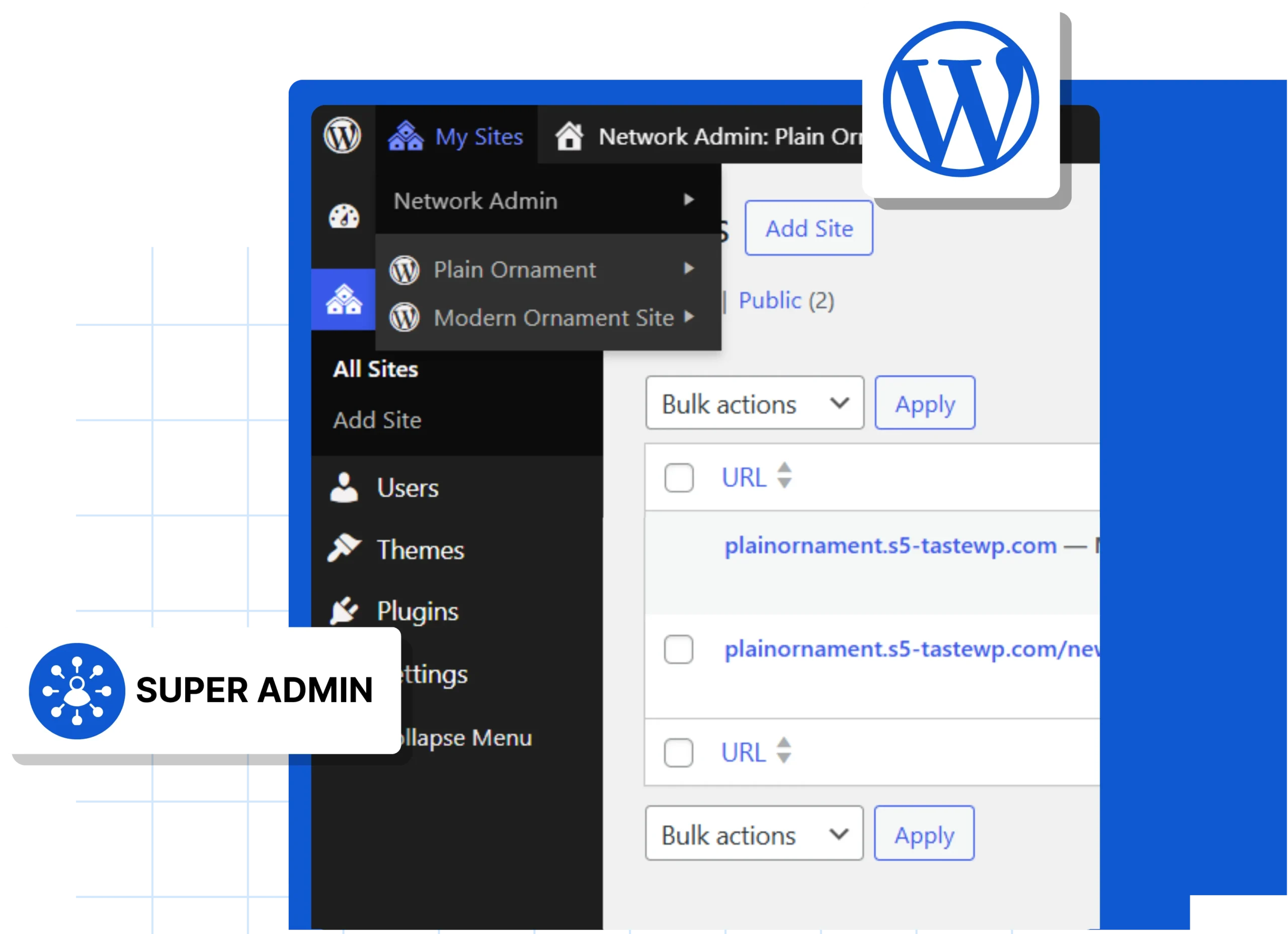

What Is WordPress Multisite
WordPress Multisite is a built-in WordPress feature that turns a single installation into a network of connected sites. Each site shares core files, themes, and plugins but keeps its own content and database tables. A super admin manages network-wide configuration, while individual site admins control content and settings for their assigned sites only. The database uses shared user tables across the network but keeps content tables separate for each site.
Manage Every Site in Your Network From One WordPress Installation
Running multiple standalone WordPress sites with updates, users, plugins, design changes, and content control becomes harder to manage. WordPress Multisite brings everything into one structured network.
Centralized Management
Handle updates, plugins, themes, and user permissions across every site in your network from one WordPress installation.
Consistent Branding With Site-Level Flexibility
Keep core standards, layouts, and essential functionality aligned across the network while each site maintains its own content and design.
Scalable Network Architecture
Build a structure that supports growth as your business adds new brands, locations, departments, or regional sites.

WordPress Multisite Works for Businesses With Multiple Brand Sites
Perfect for businesses that need separate websites for different cities, regions, or branches under one controlled system.
Useful for franchise models that need local site flexibility while keeping the overall brand and structure consistent.
A strong fit for businesses managing multiple brands that need separate websites with shared technical control.
Helpful for organizations that need different websites for departments, programs, campuses, or internal divisions.
Works well for content groups managing multiple publications, categories, or editorial properties from one framework.
Best for teams that regularly launch new websites and need a scalable way to do it without rebuilding from scratch each time.
Everything Included in Our WordPress Multisite Development Service
From architecture planning to network rollout, we cover the key parts needed to build a WordPress Multisite setup that is stable, scalable, and easier to manage long term.
Network Setup and Configuration
Full multisite installation, wp-config setup, and server-level configuration for subdomain, subdirectory, or custom domain structure.

User Role and Permission Setup
Super Admin and Site Admin roles configured with the right access levels for your organizational structure.
Domain Mapping and SSL
Custom domains mapped to individual subsites with proper DNS configuration and SSL certificates across the network.
Plugin Compatibility and Deployment
Plugins vetted for multisite compatibility, configured for network-wide or per-site activation based on requirements.
Migration and Consolidation
Existing standalone WordPress sites migrated and consolidated into your new multisite network with content, SEO, and structure preserved.
Secure Multisite Infrastructure You Can Trust at Scale
Every multisite network we build includes security measures configured at both the network level and the individual site level, so a vulnerability on one subsite does not compromise the rest of your network.
Network-level firewall and DDoS protection
Two-factor authentication for all admin accounts
File integrity monitoring across shared codebase
Automated vulnerability scanning for plugins and themes
Role-based access hardening per site and network
SSL certificates configured for every domain and subdomain
How We Build Your WordPress Multisite Network
From initial planning to network launch, every project follows a structured process built around your requirements.
01
Architecture Planning
02
Network Configuration
03
Testing and Launch
Advanced Capabilities for Growing Multisite Networks
For businesses that need more than a standard multisite setup, we build and configure advanced functionality tailored to complex network requirements.
WooCommerce on Multisite
Run independent stores across subsites with shared product logic or separate catalogs per site.
Headless Multisite Architecture
Use the multisite network as a content backend with decoupled frontends built on Next.js, Astro, or similar frameworks.
Multilingual Network Support
Configure language-specific subsites using plugins like MultilingualPress for region-based or audience-based content delivery.
Custom API Integrations
Connect your multisite network with CRMs, ERPs, analytics platforms, or internal tools through REST API or third-party services.
Ready to Build a WordPress Multisite Network?
Tell us about your project and our team will review your requirements, assess the best network architecture, and share a clear plan with timeline and scope.

Frequently Asked Questions
WordPress Multisite runs multiple sites from a single installation with shared core files, themes, and plugins. Separate installations mean independent setups for each site, each requiring its own updates, security patches, and maintenance. Multisite is better suited for organizations that need centralized control. Separate installs work when sites have completely different technical requirements or hosting needs.
Yes. Domain mapping allows every subsite to operate under its own unique domain. Visitors will not see any connection to the parent network. Each mapped domain requires proper DNS configuration and its own SSL certificate.
Yes. WooCommerce can run on a multisite network. Each subsite can operate as an independent store with its own products, payments, and shipping rules. This setup is commonly used by franchise networks and multi-regional businesses that need separate storefronts under one system.
The Super Admin has full control over network-wide settings, themes, plugins, and all subsites. Site Admins manage content and settings only for their assigned sites. Roles and permissions can be configured to match your organizational hierarchy.
Yes. Standalone WordPress sites can be consolidated into a single multisite network. Content, media, users, SEO settings, and URL structures are preserved during migration. We assess each site individually to identify compatibility requirements before consolidation begins.
Subdomains (site1.domain.com) work well for distinct brands or regional sites that need separate identity. Subdirectories (domain.com/site1) are better for content sections or departments under one brand. Custom domain mapping is a third option when each site needs a fully independent URL.
Not all WordPress plugins support multisite environments. We audit every plugin for network compatibility before deployment. Incompatible plugins can often be replaced with multisite-ready alternatives or custom-built solutions depending on the functionality required.
Performance planning is part of the architecture phase. We configure object caching, CDN integration, database optimization, and server-level settings based on the expected number of sites and traffic volume across the network.
